

Quick Answer
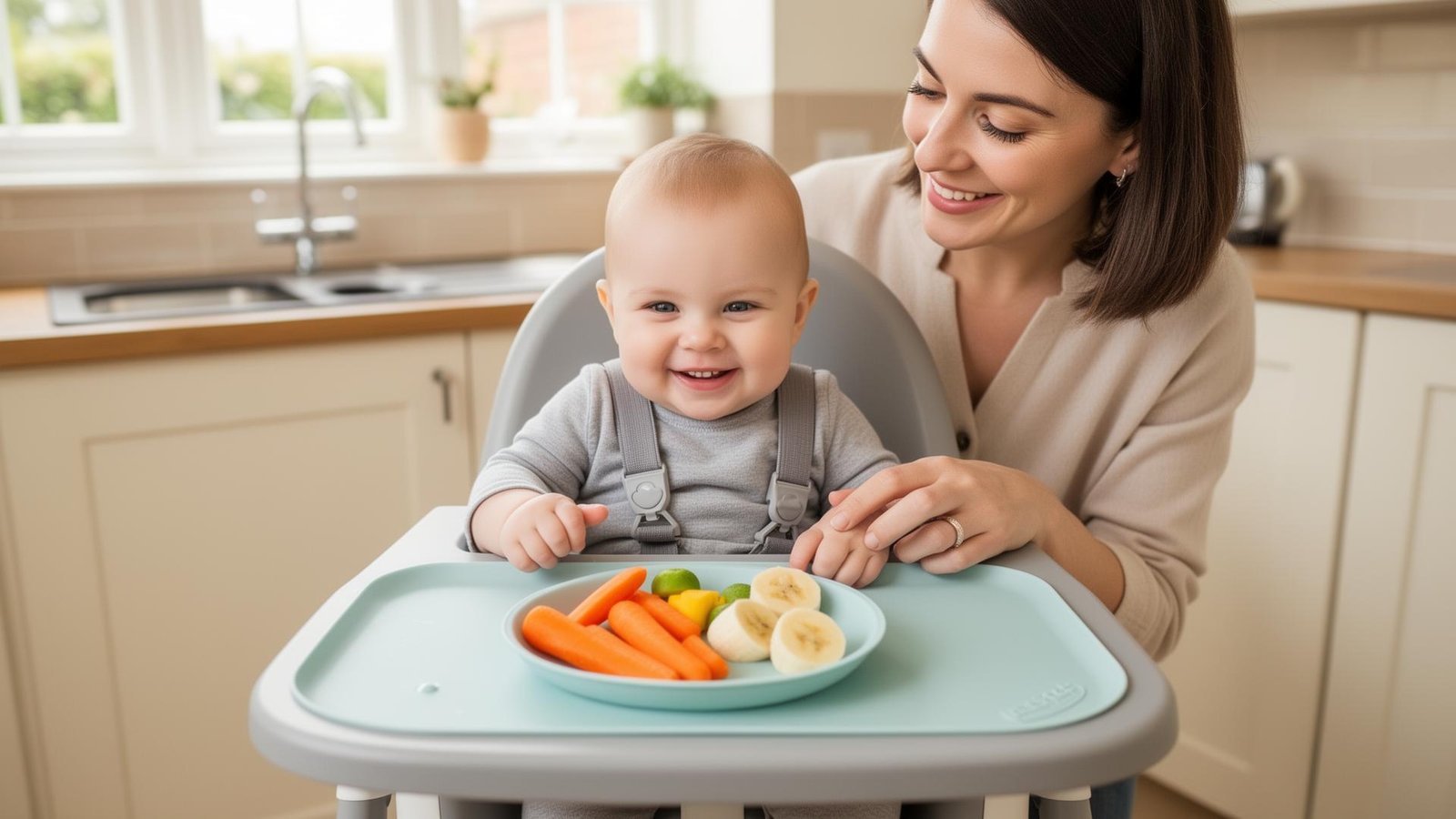
Baby-led weaning (BLW) lets your baby self-feed soft finger foods from around six months instead of spoon-fed purées. The NHS supports it once your baby can sit unaided, hold their head steady and bring food to their mouth. Start with soft, finger-sized pieces (banana, steamed carrot, avocado), never leave your baby alone while eating, and learn the difference between gagging (normal) and choking (silent — needs action).
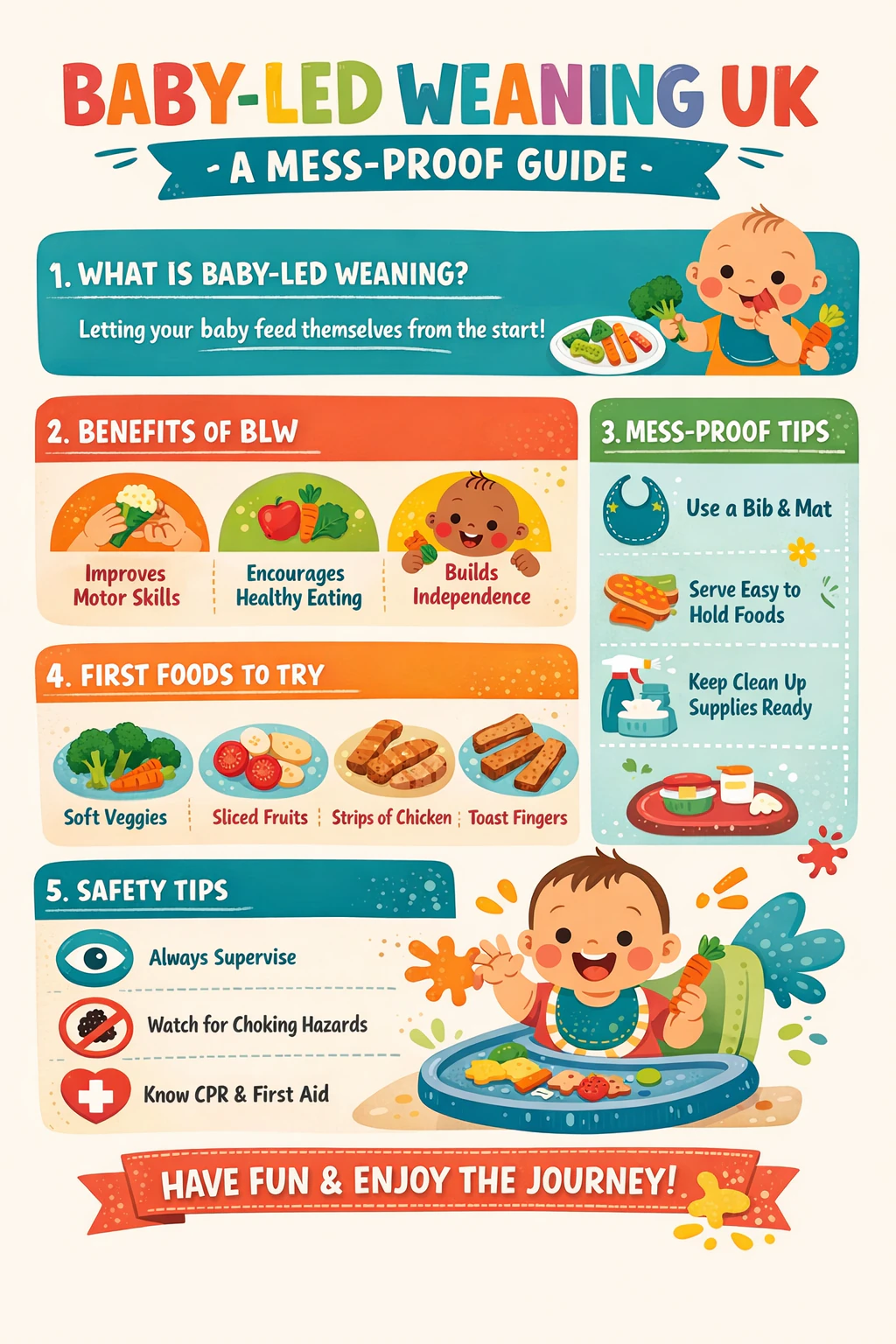
Expect mess. Use a long-sleeved bib, a splat mat under the highchair and a wipe-clean tray. Offer water in an open or free-flow cup, avoid added salt, honey and whole nuts, and follow the 7-day starter plan below to build confidence without overwhelm.
Introduction: You Are Not Behind, and You Are Not Doing It Wrong
If you are reading this with a damp cloth in one hand and a half-eaten piece of broccoli in the other, please know this: you are not behind, and you are not doing it wrong. You are simply in the middle of one of the biggest, messiest, and most emotional daily changes in family life.
Weaning looks small on paper. Ideally, a baby sits in a baby highchair, picks up a carrot, and eats it. But in real life? It feels huge. It's a kitchen that suddenly feels smaller, floors that feel permanently sticky, and a laundry pile that seems to multiply overnight.
Baby led weaning UK interest is exploding for a reason. A recent 2024 academic review noted that in March 2024 alone, there were over 50,000 Google searches for the term. Yet, despite this massive interest, the conversation often ignores the reality of the daily grind.
I'm Ella, SHC's resident family essentials tester. I live in Stockport with two toddlers and a dog who acts as our vacuum cleaner. I have scrubbed Bolognese off a beige carpet more times than I care to admit. But I am not just here to share cleaning tips; I am here to share the data that proves why this feels so hard, and the specific strategies to make it easier.
This guide is your mess-proof strategy. It is built on three pillars: Data-Driven Reassurance, NHS-Aligned Safety, and Strategic Containment. We will turn the chaos into confidence, using facts to silence the worry and products to handle the mess.
The Scale of the Weaning Challenge
🎬 Watch: The Complete BLW Guide in 6 Minutes
Who This Guide Is For (And Why It Feels So Emotional)
We need to talk about why this milestone feels so heavy. It isn't just about food; it's about your identity as a parent. The pressure to "get it right" is backed by numbers that show you are part of a massive cohort of worried parents.
According to the Office for National Statistics (ONS), there were 594,677 live births in England and Wales in 2024. That means right now, nearly 600,000 other households are likely navigating this exact same transition. You are part of a massive, silent community of parents all staring at a highchair and wondering, "Is this safe?"
The Anxiety Gap: Data vs. Reality
If you feel stressed, it is not in your head. It is in the data. A revealing study on maternal mental health during weaning showed a stark difference in anxiety levels:
- Spoon-feeding mothers: Scored an average of 8.1 on the GAD-7 (General Anxiety Disorder) scale.
- Baby-Led Weaning mothers: Scored an average of 15.3.
- The reason? Because giving up control is terrifying. When you spoon-feed, you control the portion, the pace, and the mess. When you do BLW, you hand that control to a 6-month-old.
The Science of Mess: Why It Happens and Why It Matters
Before we fix the mess, we have to respect it. The mess isn't just "bad behaviour"; it is a developmental necessity.
The Physics of Falling Food
Babies are born scientists. When they drop a piece of toast, they aren't trying to ruin your floor; they are testing gravity. Does it fall every time? Does it make a sound? Does the dog come running?
Research into infant development shows that tactile exploration (squashing, smearing, dropping) is crucial for desensitisation. A baby who is allowed to get messy with food is learning about texture before the food even hits their tongue.
The Long-Term Payoff
Is the mess worth it? The data says yes.
- Lower Fussiness: Studies tracking infants from 6 to 36 months found that those following a BLW approach had significantly lower "food fussiness" scores than spoon-fed peers.
- Better Nutrition: BLW infants were found to be 1.96 times more likely to consume red meat (a critical source of iron) at 6-7 months compared to spoon-fed babies who were mostly on fruit/veg purees.
- Self-Regulation: BLW teaches babies to stop when full, a skill linked to healthy weight management later in life.
The Problem: "Mess Anxiety" and the Homemade Trend
To solve the mess, we first have to understand the modern pressure. Using the "5 Whys" Methodology, we can drill down to the root cause of your stress.
The "Homemade" Pressure Cooker
A Mintel 2025 report on the UK baby food market highlighted a massive shift: 75% of UK parents now prepare homemade baby food daily. We are moving away from jars and pouches because we want the best for our kids. But this creates a time deficit.
- Old Way: Open jar → Feed baby → Throw jar away. (Low mess, low prep).
- New Way: Chop veg → Steam veg → Serve to baby → Baby throws veg → Clean floor → Clean baby → Wash bib. (High mess, high prep).
The Root Cause Analysis
- Why does BLW feel stressful? Because food drops, smears, and ruins surfaces.
- Why does that create anxiety? Because cleanup time adds 20-30 minutes to an already exhausted parent's day.
- Why is cleanup taking so long? Because the setup isn't designed for a "fast reset."
- Why is the setup wrong? Because many parents start with just a highchair and hope for the best, rather than building a "system."
- The Root Cause: You aren't lacking patience; you are lacking a containment strategy.
Mess-Proof BLW: The 3-Step "Wipeable Zone"
This is the "Jobs to be Done" framework in action. You aren't trying to "buy a mat"; you are trying to "hire" a solution to buy back 120 hours of your life (20 minutes × 3 meals × 365 days).
Step 1: Protect the Floor and Your Time
Stop cleaning the whole room. Clean one zone.
- The Splash Mat: Put a large (120cm+) wipeable splat mat under the highchair. If you have carpet, this is non-negotiable.
- The "Discard" Bowl: Keep a small bowl on the table for bits the baby rejects or drops. Do not walk back and forth to the bin during the meal.
- The Two-Cloth System: One damp cloth for hands/face, one for the table. Do not cross-contaminate the mess.
Essential BLW Equipment & Benefits
Step 2: Make the Highchair Work for Baby
A stable sitting position reduces slumping and, surprisingly, reduces throwing. If a baby feels unstable, they fidget and swipe to find balance.
- Check 1: Baby sits upright with good head control (no slumping to the side).
- Check 2: Foot support is present. Their feet should be flat at a 90-degree angle. If your highchair has no footrest, use a resistance band or a stack of books as a hack.
- Check 3: Tray height supports elbows resting comfortably. If the tray is at neck height, they can't control their arms, leading to more mess.
Step 3: Choose the Right Tools
Early-stage baby led weaning at 6 months UK works better with specific tools designed to counter gravity.
- Suction bowls: These create a vacuum seal with the tray. While a determined toddler can unstick them, it stops the accidental "swipe" that knocks dinner onto the floor.
- Short-handled spoons (dippers): Long spoons are for parents; short, chunky spoons are for baby fists. They are easier to aim, meaning more yoghurt ends up in the mouth and less on the nose.
- Small open cups: Use a tiny cup (shot-glass size) for water. Large sippy cups encourage "shaking," which leads to spraying.
Safe Food Prep: Reducing Risk and Mess
Safety is the number one barrier for UK parents. Government research for the Better Health Start for Life campaign highlighted that "confusion over safe prep" is a primary reason parents delay solids. Let's align with the facts.
The NHS Readiness Checklist
NHS guidance is clear: wait until around 6 months. Look for these three signs together:
- Sign 1: Baby stays in a sitting position and holds their head steady.
- Sign 2: Baby coordinates their eyes, hands, and mouth so they can look at the food, pick it up, and put it in their mouth.
- Sign 3: Baby swallows food (rather than spitting it back out).
Safe Prep Rules UK Parents Search For
Baby led weaning choking risk and safe prep is a top search query. The rule of thumb is "Squishable & Stick-Shaped."
- Grapes & Cherry Tomatoes: The biggest choking hazards. Always cut lengthwise into quarters. Never offer whole.
- Carrots & Apples: Never raw. Steam or roast until soft enough to squash between your fingers easily.
- Nuts: Never whole. Offer as smooth nut butter thinned with water, or as ground powder mixed into porridge.
- Sausages/Hot Dogs: Cut into quarters lengthways, then chop. Never cut into coin shapes.
The 7-Day Mess-Proof Starter Plan
This plan is designed for baby led weaning first foods UK. It focuses on Iron-Rich foods early on, as babies' iron stores from birth begin to deplete around 6 months—a key medical reason to start solids.
Day 1: One Soft Vegetable (The Low Stakes Start)
- Menu: Steamed carrot sticks or sweet potato wedges (roasted for better grip).
- Goal: Learn baby's pace. Do not chase bites.
- Mess Level: Low (Solids brush off easily).
Day 2: One Fruit (The Grip Test)
- Menu: Ripe banana spears (break naturally, don't cut with a knife as it gets slimy) or very ripe pear slices.
- Goal: Handling slippery textures.
- Mess Level: Medium (Banana is sticky).
Day 3: A Carbohydrate Finger Food (Motor Skills)
- Menu: Toast fingers (lightly toasted) with unsalted butter or soft fusilli pasta (easier to grab than penne).
- Goal: Practice chewing and moving food in the mouth.
- Mess Level: Low (Crumbs).
Day 4: Protein Intro (Critical Nutrient)
- Menu: Shredded soft chicken (thigh is moister than breast) or flaked salmon (bones double-checked).
- Goal: Introducing iron/protein.
- Mess Level: Medium (Greasy hands).
Day 5: The Pre-Loaded Spoon (The Yoghurt Challenge)
- Menu: Plain Greek yoghurt or coconut yoghurt. You load the spoon, and place it on the tray. Baby picks it up.
- Goal: Hand-eye coordination.
- Mess Level: High (Red Alert). Use the "Sink Bath" strategy today.
Day 6: Mix Two Safe Foods (Meal Composition)
- Menu: Avocado slices rolled in crushed cereal (adds grip) + Toast fingers.
- Goal: Managing different textures simultaneously.
- Mess Level: Medium.
Day 7: Family Meal (The Gold Standard)
- Menu: Baby eats a safe, low-salt version of your Sunday roast (soft veg, meat strips, potato).
- Goal: Social eating.
- Mess Level: Variable.
The "Sink Bath" Strategy: A Cleanup Revolution
Here is a secret from the trenches of mess free baby led weaning. It sounds extreme, but it is the most effective way to handle "wet" messes like porridge or Bolognese.
The Protocol
For the messiest meals, do not attempt to clean the baby in the chair.
- Strip down: If the house is warm, feed the baby in just a nappy. The skin wipes cleaner than cotton.
- The Lift: When finished, do not wipe their face (which often causes tears). Lift the baby straight out of the chair, holding them under the armpits to avoid the messy hands.
- The Sink: Pop them directly into a kitchen sink filled with warm water and a drop of bubble bath.
- The Result: They think it's playtime. You wash them clean in 30 seconds without using a single wet wipe.
- The Cost Saving: By skipping the 10-15 wipes you'd normally use for a messy meal, this strategy saves you money and saves the environment.
Personal Recommendation: The "3 Saves" Kit
As someone who analyzes products for SHC Family Essentials, I see a lot of gimmicks. You do not need a £200 steaming machine. You need a small set of items that remove the biggest daily stress points. I call this the "3 Saves" approach.
1. Save Your Laundry: The Coverall Bib
Standard bibs are useless against a bowl of pasta. You need a best bib for baby led weaning—specifically a "coverall" style that covers arms and connects to the tray or covers the lap.
- Why: When you reduce outfit changes, you reduce pressure. Parents often feel tense because a stained vest feels like a failure. A protective bib helps you stay calm.
- The ROI: If a coverall bib saves 3 outfits a week, that is 156 fewer loads of spot-cleaning laundry a year.
2. Save Your Food: The Suction Plate
Many babies flip plates to test gravity. It's physics, but it's annoying.
- Why: When a plate stays put, the baby focuses on eating and exploring rather than throwing. You also avoid the frustration of re-serving the same meal three times.
- The Insight: Look for plates with curved edges. This helps the baby "scoop" the food against the side of the bowl, aiding motor skill development.
3. Save Your Floor: The Splash Mat
This one changes everything. Instead of cleaning the whole kitchen, you clean one surface.
- Why: You can shake it into the bin and wipe it down with spray. It turns "mess everywhere" into "mess contained."
- The Hack: In a pinch, a disposable tablecloth works, but a reusable PVC mat stays flat and doesn't bunch up when the highchair moves.
Conclusion: Embrace the Chaos (But Contain the Mess)
Standing in your kitchen, looking at a highchair covered in sauce, remember the data: 45% of parents find this stressful, and nearly 600,000 others are going through it this year. You are not alone in the chaos.
The mess is temporary. The skills your baby is learning—independence, dexterity, appetite regulation—last a lifetime. By equipping yourself with a "wipeable zone," understanding the science behind the mess, and using the right SHC Family Essentials, you turn mealtime from a battleground into a playground.
Let's make weaning fun again. You've got this.
Ready to Reclaim Your Clean Floors?
Visit SHC Family Essentials on eBay today to find affordable splash mats, suction plates, and coverall bibs that make BLW manageable.
Shop Weaning Essentials Subscribe to our blog for next week's guide on "Batch Cooking for Busy Parents."