

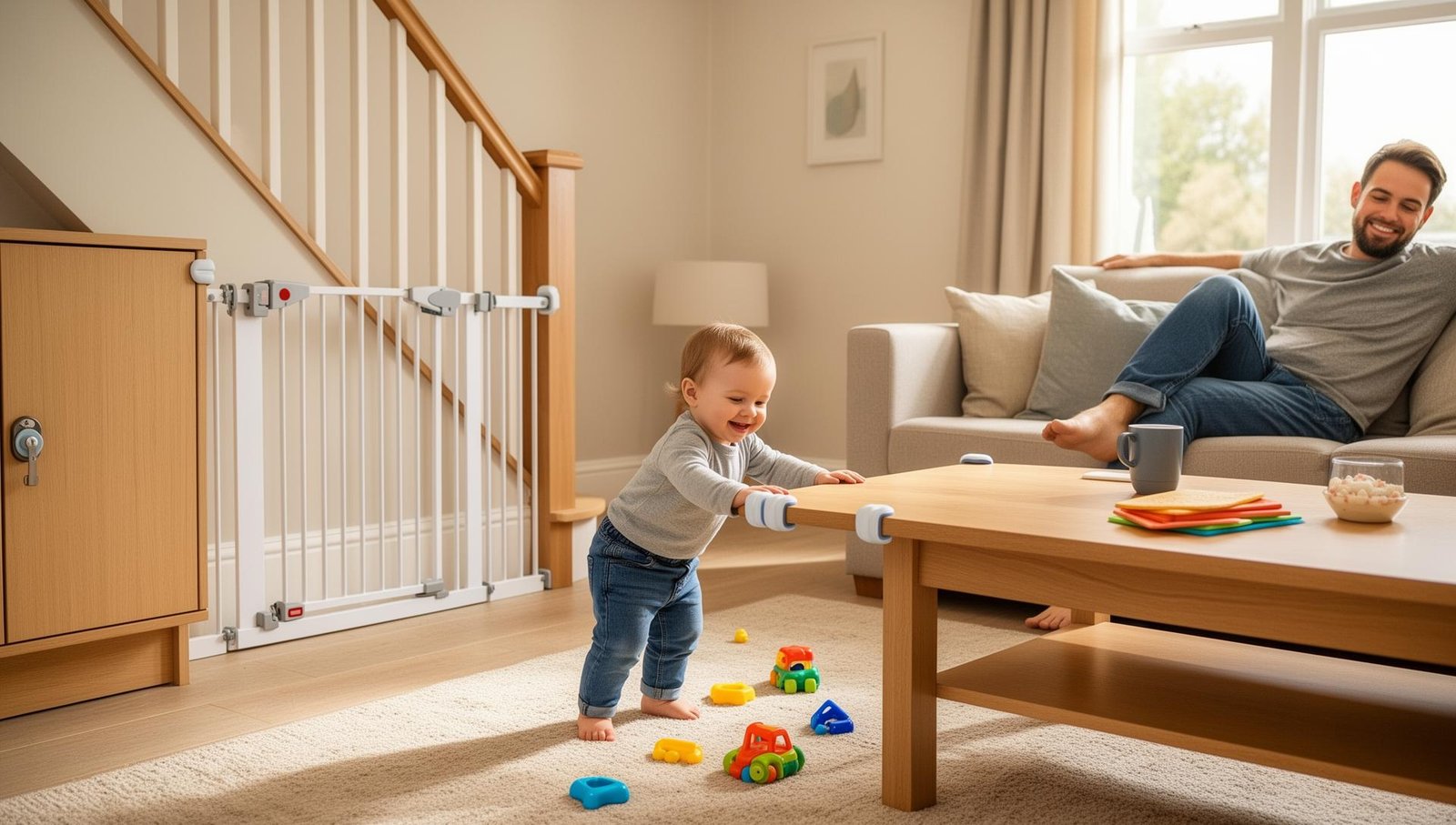
Quick Answer
Baby-proof your UK home in four priority zones before your baby starts crawling (around 6–9 months): stairs (top and bottom safety gates, fitted not pressure-mounted at the top), kitchen (cupboard latches, oven lock, hob guard, sharp-edge corner protectors), bathroom (toilet lock, non-slip mat, lockable medicine cabinet, water heater capped at 46°C) and living areas (TV anchored to the wall, blind cords secured, plug socket covers, fireguard).
Budget around £150–£250 for a full first sweep using own-brand essentials, or £400+ for premium kits. Re-assess every three months — hazards change as your baby learns to pull up, climb and reach higher. The room-by-room checklist below lists every product and fitting in order of urgency.
Introduction: The Weight of a Single Moment
It happens in a heartbeat. One moment, you are sipping your tea, watching your 9-month-old happily playing on the rug. The next, the phone rings, you turn your head for three seconds, and suddenly—silence.
Every parent knows that specific silence. It's the silence that sends a jolt of adrenaline through your veins. You rush to the hallway and find your little one at the bottom of the stairs, looking up at you, surprised but thankfully unhurt. You catch your breath, your hands trembling, promising yourself, "I will install that gate today. No more excuses."
If this scenario feels familiar, you are not alone. It is a rite of passage for almost every parent. But for too many families in the UK, the story doesn't end with a sigh of relief.
UK Child Safety Statistics
The Alarming Gap in Home Safety
Despite these numbers, a recent survey revealed a startling gap in our home defenses:
- 41% of parents have never installed cupboard locks
- 37% of parents have no stair gate in place
- 50% of parents do not use a hob guard in the kitchen
Why Baby Proofing Matters: Beyond the Statistics
We often talk about "accidents," but safety experts prefer the term "preventable injuries." The word "accident" implies bad luck, but a toddler falling down unguarded stairs is not bad luck—it is physics.
The "Top Heavy" Toddler
Understanding why babies get hurt helps us protect them. Toddlers are anatomically different from adults. Their heads are disproportionately large compared to their bodies, shifting their center of gravity upwards. This makes them "top-heavy."
When a toddler loses their balance, they don't just sit down; they topple head-first. This is why falls from furniture, down stairs, or out of windows almost always result in head injuries.
The "Oral Explorer"
Babies explore the world through their mouths. This biological drive is crucial for development but dangerous in a modern home. A brightly coloured laundry capsule looks like a sweet. A button battery looks like a coin. Ingestion of these items can cause chemical burns or poisoning in minutes.
When Should You Start? The "Crawling Countdown"
The most common mistake parents make is waiting until the baby is moving to start baby proofing. This is a dangerous gamble. You need a "Prevention Lead Time" of at least one month.
Development Phases & Safety Timeline
- The "Rolling" Phase (0-6 Months): Your baby isn't mobile yet, but they can roll. Never leave a baby unattended on a changing table or sofa. This is the "Planning Phase" — use this time to buy your equipment while you still have energy.
- The "Crawling" Phase (6-9 Months): This is "Go Time." Most babies start crawling between 7 and 10 months, but some start as early as 6 months. By the time your baby can sit up unsupported, your house needs to be ready.
- The "Cruising" Phase (9-12 Months): "Cruising" is when a baby pulls themselves up on furniture to stand. Suddenly, the coffee table isn't just an obstacle; it's a handle. Hazards that were out of reach are now in the danger zone.
Essential Baby Proofing Products: Your UK Buying Guide
The market is flooded with gadgets, but you don't need everything. You need the right things. Here is a breakdown of the non-negotiable essentials.
1. Safety Gates: The First Line of Defence
Stairs are the number one hazard. But not all gates are created equal.
- Pressure-Fit Gates: These hold themselves up by pushing against the walls. They are great for doorways and the bottom of stairs.
- Screw-Fit Gates: These are anchored into the wall with screws. CRITICAL: You MUST only use screw-fit gates at the top of stairs. Pressure gates have a bar running along the floor that is a major trip hazard.
2. Cabinet Locks: The "Invisible Shield"
- Magnetic Locks: These are the gold standard. They are installed inside the cupboard and are invisible from the outside. You open them with a magnetic "key." They are brilliant because toddlers cannot figure them out.
- Strap Locks: These stick to the outside of the furniture. They are cheaper and easier to install (no drilling), making them perfect for renters.
3. Corner Guards
Coffee tables are usually at the exact height of a toddler's eye socket or temple. Soft, impact-absorbing foam corner guards are essential for protecting against nasty bumps and cuts.
4. Furniture Anchors (The Lifesavers)
This is the most overlooked item. A climbing toddler can pull a heavy chest of drawers or a flat-screen TV down onto themselves. Anti-tip straps are cheap, simple to install behind the furniture, and they save lives.
Room-by-Room Strategy: Your Action Plan
Let's break this down into bite-sized tasks so you don't feel overwhelmed.
The Kitchen: The High-Risk Zone
The kitchen is responsible for the most serious burns and poisonings.
- Chemical Lockdown: Move all cleaning products, especially laundry pods and dishwasher tablets, to a high cupboard. If they must stay under the sink, use a heavy-duty Magnetic Lock.
- The Hob: Toddlers reach up. Install a Stove Guard and get into the habit of turning pan handles inward.
- Appliance Safety: Unplug kettles and toasters when not in use. A dangling kettle cord is a temptation for a child to pull.
- The Oven: Glass oven doors can get incredibly hot. Install an Oven Door Lock and consider a heat-resistant film.
The Living Room: The Play Zone
This is where you spend the most time, so it needs to be the safest.
- TV Safety: If your TV is on a stand, anchor it. Modern flat-screens are light but unstable.
- Blind Cords: This is a silent killer. Looped blind cords can strangle a child in seconds. Install a cleat to wind the cord up high, or switch to wand-operated blinds.
- Fireplaces: A spark guard isn't enough. You need a Nursery Guard—a cage that fixes to the wall and surrounds the entire hearth.
- Glass Furniture: If you have a glass coffee table, consider putting it in storage for a few years. If not, apply extensive edge bumpers.
The Bathroom: Water & Heat
- Toilet Locks: It sounds strange, but toddlers are fascinated by water. A toilet lock prevents drowning risks and stops them from throwing toys into the bowl.
- Water Temperature: Set your water heater to a maximum of 48°C (approx 118°F) or install thermostatic mixing valves (TMVs) on your taps to prevent scalding.
- Medicines: Never leave medicines on the counter. Lock them in a high cabinet.
Stairs & Hallways
- Gate Logic: Install gates at the top AND bottom of the stairs.
- Banister Gaps: Check the spindles on your banister. If you can fit a soda can (approx 6.5cm) through the gap, a baby's head can get stuck. Use a mesh banister guard.
- Clutter: Keep the stairs clear. A toy car on the stairs is a hazard for you as much as the baby.
Common Baby Proofing Mistakes to Avoid
Even well-intentioned parents make mistakes. Here are the traps to avoid:
- The "Socket Cover" Myth: In the UK, our plug sockets (BS 1363) are designed with internal shutters that are safer than any plastic insert. In fact, cheap plastic socket covers can actually bypass the built-in safety mechanisms. The safest socket is a standard, uncovered UK socket.
- Relying on "Baby Monitoring" Tech: A camera is not a babysitter. It allows you to see the accident happen, but it doesn't prevent it. Technology is a backup; physical barriers are the primary defence.
- "They Can't Reach That Yet": Babies grow overnight. Just because they couldn't reach the handle yesterday doesn't mean they can't today. Always proof one stage ahead.
- Forgetting "Grandma's House": You might have Fort Knox at home, but visiting grandparents who have medication on the bedside table puts your child at risk. Create a "Portable Safety Kit" for visits.
Frequently Asked Questions (FAQs)
Can I baby proof on a budget?
Absolutely. Focus your budget on the "High Risk" items: Stair gates and furniture anchors. For cupboards, you can use cheaper slide locks or even hair ties on double handles as a temporary fix. However, never skimp on the stair gate—safety standards matter there.
My landlord won't let me drill holes. What do I do?
This is a common issue for renters. For the bottom of stairs and doorways, use pressure-fit gates which leave no marks. For the top of stairs, try to negotiate—explain to your landlord that a screw-fit gate is a life-saving device. Offer to fill and paint the holes when you leave.
When can I take the stair gates down?
Most experts recommend keeping gates up until the child is at least 2 years old, or until they learn to climb over the gate (at which point the gate becomes a falling hazard).
Are second-hand car seats and gates safe?
Second-hand gates are generally fine if you check that all parts are present and the locking mechanism works. However, NEVER buy a second-hand car seat—you cannot know if it has been in a crash, which weakens the plastic invisibly.
Your 3-Step Weekend Action Plan
If you've read this far, you might be feeling a mix of motivation and overwhelm. That is normal. The list seems long. But remember: You don't have to do it all in one day.
- Saturday Morning: Do the "Crawl Audit." Identify your top 3 hazards (usually the stairs, the cleaning cupboard, and the TV).
- Saturday Afternoon: Order your essentials. Visit SHC Family Essentials and grab a "Starter Kit" of locks and your gates.
- Sunday: Clear the clutter. Move the cleaning products high up. Tie up the blind cords. You can do these things for free, right now.
Conclusion: Creating a "Yes Environment"
Baby proofing isn't about creating a padded cell. It's about creating a "Yes Environment"—a space where your child is free to explore, learn, and play without you having to hover over them saying "No, stop, dangerous!" every two minutes.
It's about giving yourself the gift of relaxation. It's about knowing that when you put your head on the pillow at night, you have done everything in your power to keep them safe.
So, take a deep breath. You've got this. And for the gear you need to get the job done, we're here to help.
Stay safe, stay prepared, and enjoy these precious years.
Ready to Transform Your Home Into a Safe Haven?
Visit SHC Family Essentials on eBay today to find affordable, UK-standard safety gates, locks, and guards.
Shop Baby Safety Products Subscribe to our blog for more weekly tips on parenting, safety, and home hacks.