

Quick Answer
The genuine essentials a new UK parent needs in 2025 are: a safe sleep setup (Moses basket or cot, firm mattress, two fitted sheets, TOG-rated sleeping bags), feeding kit (either breastfeeding pillow and pump, or 4–6 anti-colic bottles and steriliser), nappy supplies (newborn nappies, sensitive wipes, changing mat, nappy cream) and outings gear (Group 0+ car seat, pram suitable from birth, baby carrier).
Skip the marketing-driven 'must-haves' that 1 in 5 UK parents regret buying: wipe warmers, baby food makers, dedicated bottle dryers, shoes for non-walkers and most 'newborn' size clothes (babies grow out of them in 2–3 weeks). Following this list typically saves £200–£400 versus a full retail starter kit.
The Truth About Becoming a New Parent (And Why You're Not Alone in Feeling Lost)
You've waited for this moment for months. The nursery is prepared, the pram is assembled, and the due date is circled on the calendar in red pen. But deep inside, there's a question nobody quite answers honestly: Am I really ready?
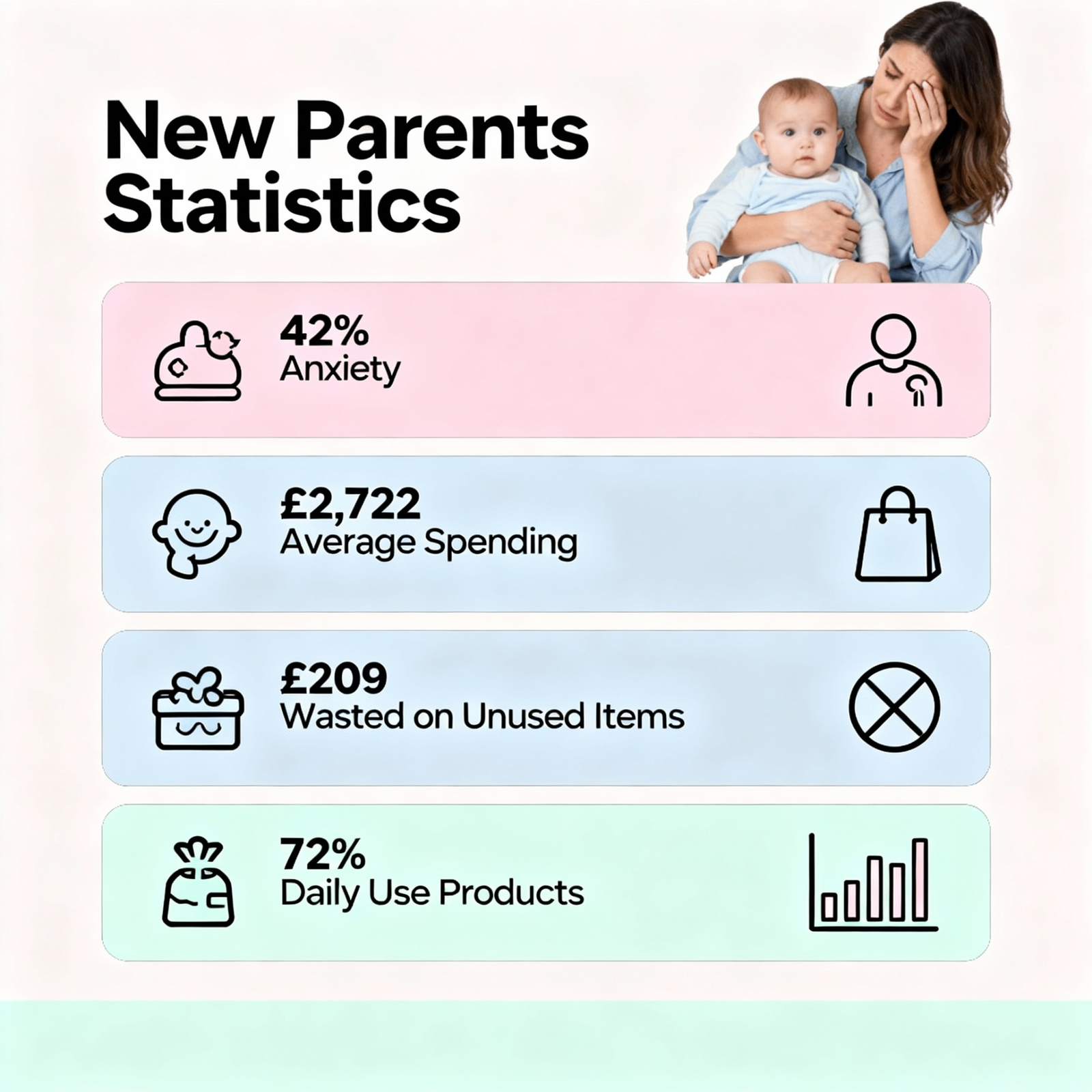
The truth is, new parenthood is one of life's most beautiful—and most overwhelming—experiences. Recent research shows that 42% of new parents experience significant anxiety within the first month, and 1 in 5 feel genuinely overwhelmed by the enormity of it all. You're not weak for feeling this way; you're human. And you're in the company of hundreds of thousands of UK parents navigating the same sleepless nights, the same self-doubt, and the same desperate search for the 'right' products to make everything feel more manageable.
The real problem isn't that you need more stuff—it's that you need the right stuff. Research from Very.co.uk reveals that new parents spend an average of £2,722 on baby essentials, yet £209 of that is spent on items they never actually use. That's nearly 8% of your investment wasted on products marketed as 'must-haves' that simply don't earn their place in your home.
This guide isn't about selling you everything. It's about helping you become a more confident parent by understanding which products genuinely solve the real problems you'll face in those critical early weeks. Because the most valuable thing a new parent can have isn't more stuff—it's the peace of mind that comes from knowing you've made thoughtful choices.
Key Statistics Every New Parent Should Know
The Real Problems New Parents Face (And Why Understanding Them Matters)
Before we talk about products, let's talk about problems. And the good news? Every problem you're about to face has been faced by thousands of other parents. You're not broken; you're just uninformed. Let's change that.
Sleep Deprivation: The Challenge That Changes Everything
Sleep deprivation isn't just about feeling tired—it's the single most cited challenge by new parents in the UK. When you haven't slept properly in days, everything feels harder. Your judgment becomes cloudy. Your emotions are raw. The smallest frustration feels catastrophic.
And here's the thing: you can't stop your baby from needing nighttime feeds and nappy changes, but you can have products that make these night routines smoother, safer, and infinitely less stressful.
The Anxiety That Nobody Warns You About
Up to 20% of new parents experience anxiety or post-traumatic stress in the first month. This statistic, compiled by NHS NIHR, isn't meant to frighten you—it's meant to normalize what you're feeling.
New parents often worry: 'Am I doing this right?' 'Is my baby safe?' 'What if I don't know what I'm doing?' These aren't signs of failure; they're signs you care deeply about your child. The right products can transform anxiety into confidence by helping you feel more in control and prepared.
Breastfeeding Challenges: The Unexpected Struggle
40% of mothers struggle with breastfeeding initially, yet many feel too embarrassed or unsupported to ask for help. Latch problems, sore nipples, engorgement—these aren't rare complications; they're common experiences. And they're completely solvable with the right support tools and products.
The Essential Baby Products Every New Parent Actually Needs
Now that we've acknowledged the real challenges, let's talk solutions. The following products aren't luxury items—they're tools that address genuine needs and solve real problems. Each category represents something parents use every single day.
Sleep Solutions: When Your Baby's Rest (And Yours) Matters Most
The Challenge: Your newborn won't sleep without being held. The nursery is cold. You're terrified of overheating or SIDS. You're exhausted and making poor decisions.
The Solution: Quality sleep products that create a safe, comfortable environment for your baby.
- Sleep Sacks or Swaddle Wraps (£25-£35): Rather than loose blankets (a SIDS risk), sleep sacks provide warmth and security. 72% of parents use these daily, making them one of the most essential purchases. They create a safe sleep environment while keeping your baby cozy throughout the night.
- Baby Monitor with Temperature Control (£60-£150): One of the most anxiety-reducing purchases you'll make. Being able to see and hear your baby from another room transforms anxiety into peace of mind. Modern monitors include temperature sensors, night vision, and two-way audio.
- White Noise Machine (£15-£40): Creates a womb-like environment that helps babies sleep deeper and longer. An extra two hours of your baby's sleep means two hours for you to rest, think clearly, and be a better parent.
- Blackout Curtains (£20-£50): Darkness triggers melatonin production in babies. Installing blackout curtains can extend morning sleep by 30-60 minutes—a game-changer for exhausted parents.
Feeding & Breastfeeding Support: Because Fed Is Best, But Support Matters
The Challenge: Breastfeeding is marketed as 'natural,' but nobody tells you it's painful, difficult, and requires learning. Your confidence is shattered when latch problems cause soreness. Whether you're breastfeeding, formula feeding, or combining both, you need the right tools.
The Solution: Products that make feeding easier, safer, and more comfortable for both you and your baby.
- Nursing Pillow (£20-£40): Reduces strain on your back and arms during feeds, positioning your baby correctly to prevent latch problems. Essential for comfortable feeding sessions.
- Nipple Cream or Balm (£5-£12): Products like Lansinoh are proven to reduce soreness from incorrect latching. Affordable, effective, and immediately confidence-building.
- Breast Pump (Manual £15-£30 / Electric £80-£250): Whether for returning to work, building a freezer stash, or relieving engorgement, a breast pump provides flexibility and control.
- Anti-Colic Baby Bottles (£3-£5 each): Bottles designed to reduce air intake prevent colic and excessive gas. Invest in at least 6-8 bottles to avoid constant washing.
- Bottle Sterilizer (£25-£60): Microwave or electric sterilizers eliminate genuine hygiene concerns. Electric sterilizers can process 6+ bottles at once.
- Burp Cloths (£10-£15 for a pack): Babies spit up—a lot. Having 8-10 burp cloths means you're not constantly doing laundry.
Nappy Changing & Care: The Routine You'll Do 8-12 Times Daily
The Challenge: You'll change approximately 2,500-3,000 nappies in your baby's first year. Every single one requires a safe, hygienic space.
The Solution: Products that make this essential routine quick, safe, and manageable.
- Changing Mat or Table (£20-£100): A designated, hygienic space prevents back strain and keeps your baby safe with safety straps and storage compartments.
- Nappy Rash Cream (£3-£8): Bepanthen or similar zinc-oxide products prevent painful nappy rash. Apply at every change to create a protective barrier.
- Baby Wipes (£2-£5 per pack): You'll use thousands. Buy fragrance-free, sensitive-skin varieties in bulk.
- Nappy Disposal System (£10-£30): A specialized bin with odor-sealing technology keeps your nursery smelling fresh.
Clothing & Comfort Essentials
The Challenge: Babies grow incredibly fast and go through multiple outfit changes daily.
The Solution: Practical, comfortable clothing that's easy to change and wash.
- Bodysuits/Onesies (£2-£5 each): Buy at least 10-12 in various sizes. These form the foundation of your baby's wardrobe.
- Sleep Suits (£5-£10 each): All-in-one outfits with integrated feet. Buy 5-7 to ensure you always have clean ones.
- Scratch Mittens (£3-£6 for a pack): Prevent newborns from scratching their delicate face.
- Cotton Blankets (£8-£15 each): Versatile for swaddling, tummy time, or emergency changing mats. Buy 3-4 lightweight options.
Bath Time & Hygiene
The Challenge: Bathing a slippery newborn can be nerve-wracking.
The Solution: Simple, effective bath products that prioritize safety and gentleness.
- Baby Bath Tub or Insert (£10-£35): Provides secure support during bath time.
- Soft Hooded Towels (£8-£15 each): Extra-gentle, absorbent towels. Buy 2-3.
- Baby Shampoo & Wash (£3-£8): Fragrance-free, tear-free formulas for sensitive skin.
- Bath Thermometer (£3-£8): Prevents burns and ensures comfort.
Transportation & Travel
The Challenge: Getting out of the house with a newborn feels like planning a military operation.
The Solution: Quality transport equipment that makes outings manageable and safe.
- Pram/Pushchair (£150-£600+): One of your biggest investments. Look for models that convert from lie-flat to upright positions.
- Car Seat (£80-£300): Non-negotiable for safety and legally required.
- Baby Carrier or Sling (£30-£120): Keeps baby close while keeping your hands free. Many parents say this saved their sanity.
- Changing Bag (£25-£80): A well-organized bag makes outings far less stressful.
Smart Shopping: How to Avoid Wasting £200+ on Products You Won't Use
Recent research shows new parents waste an average of £209 on items they never actually use. Here's how to avoid joining that statistic.
Smart Shopping Strategies
- Buy essentials new: Items that touch baby's mouth or involve safety (car seats, sleep products, feeding bottles) should be purchased new.
- Consider secondhand for: Cots, prams, high chairs, toys, and clothing—often found at 50-70% off retail.
- Avoid brand snobbery: A £25 sleep sack works as well as a £65 designer one.
- Wait before buying: Many 'essentials' aren't needed immediately. Buy for the first month, then add based on experience.
- Accept hand-me-downs: Fellow parents often have excellent-quality items their babies have outgrown.
Budget Allocation Guide
If you're working with the average £2,722 budget, here's a smart allocation:
- Sleep & Safety (£300-£500): Cot, mattress, sleep sacks, monitor.
- Feeding (£150-£300): Breast or bottle feeding support equipment.
- Nappies & Care (£400-£600 for first year): Buy in bulk when on sale.
- Clothing (£150-£250): Buy sizes 0-3, 3-6, and 6-9 months as you go.
- Transportation (£300-£800): Pram and car seat—invest in quality here.
- Bath & Hygiene (£50-£100): Simple, essential items.
- Buffer (£400-£600): For unexpected needs and replacements.
Your Real-Life Action Plan: What to Buy First
Before Baby Arrives (Essential Purchases)
- Sleep sacks/swaddles (2-3)
- Fitted cot sheets
- Sterilizer (if planning to bottle feed)
- Changing mat
- Nappy rash cream
- Basic baby bath
Your First Week (After You Know Your Baby)
- Baby monitor (choose after assessing your home setup)
- Nursing pillow (if breastfeeding)
- Bottles and teats (choose after baby's first feed)
What to Skip Entirely
- Wipe warmers
- Fancy bedding sets (safety risk)
- Most nursery gadgets
- Items designed to solve problems you don't have
The Emotional Truth: You're Going to Be Okay
Here's what nobody tells you clearly enough: You're going to make mistakes. You're going to worry excessively about small things. You're going to wonder if you're doing it right. And that's exactly what good parents do.
Twenty-eight percent of new mothers report feeling so overwhelmed by early parenthood that they struggle to ask for help. But research consistently shows that parents who receive support—whether emotional, practical, or informational—recover faster and bond better with their babies.
Having the right products isn't about perfection; it's about removing unnecessary barriers between you and your baby. It's about reducing anxiety so you can focus on the actual miracle: a new human who needs you, and a version of you that's learning to be a parent.
The sleepless nights will pass. The anxiety will soften into confidence. And you'll realize that the most essential 'product' was never something you could buy—it was the support, information, and permission to do this imperfectly.
Key Statistics Summary
Additional Resources for New Parents in the UK
- NHS Health Visitor Support: Free, professional support available to every new parent
- Your Local Children's Centre: Free classes, support groups, and product advice
- La Leche League UK: Breastfeeding support and information
- NCT (National Childbirth Trust): Parenting classes and support networks
- Samaritans: 24/7 emotional support (116 123)
Conclusion: You've Got This—And You're Not Alone
Becoming a new parent is one of life's greatest adventures and one of its most daunting challenges. The products you choose matter, but only because they support you—a real person navigating one of life's most significant transitions.
You don't need everything. You need the right things. And more importantly, you need to know that what you're feeling—the anxiety, the exhaustion, the overwhelming love mixed with paralyzing doubt—is completely normal and completely manageable with the right support and tools.
Start with the essentials outlined in this guide. Avoid the marketing hype. Trust your instincts. And remember: the fact that you're researching this, reading guides, and trying to make informed decisions means you're already the parent your baby needs.
Welcome to parenthood. You're going to be amazing.